
In the case study “What is the Best Way to Get Devices Programmed,” BPM Microsystems explored six main ways to get your data on devices. The answer is “Depends.” The short answer is there is no one way that is always better than another. This case study explores two of those six methods: Inline SMT programming and Off-line programming.
A small segment of electronic manufacturing services (EMS) and Original Equipment Manufacturers (OEMs) can use inline programming solutions effectively and economically, compared to off-line programming. A lack of flexibility, high cost, and the specter of obsolescence should raise questions about the long-term viability of Inline programming.
Inline SMT Programming
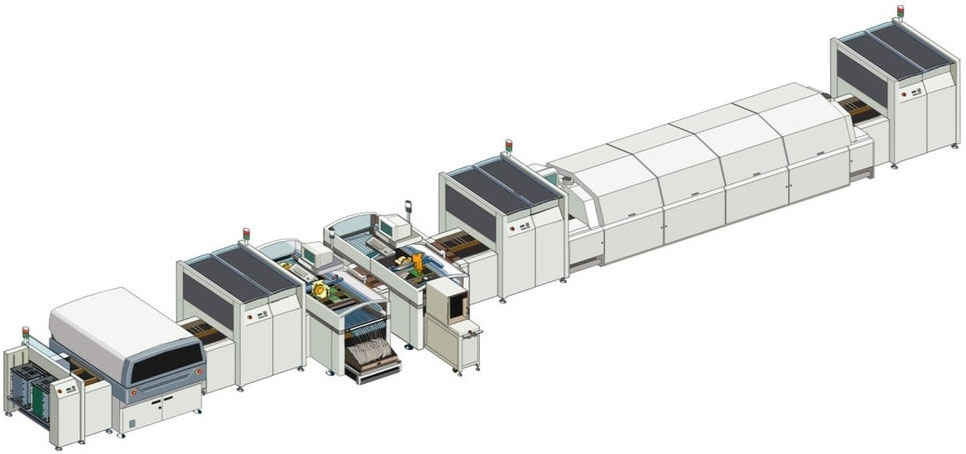
Inline SMT programming is a solution to consider for narrow segments of device programming requiring short programming times, with medium to high volume, for just one device type. Back in the day, that’s what programmed some of the most popular cell phones, when on-board memory sizes were Mbits compared to today’s designs with Gbit memory sizes. Benefits of inline programming include just-in-time programming (which has its own problems lately; see article here), simplified inventory management, and lean manufacturing. If that sounds like your process, and that process won’t change in the next five years, inline programming should be considered (or possibly programming at test, but that’s for a future article).
There are inline SMT programming solutions available on the market; some are commercial, and others are sophisticated but expensive home-grown systems designed for specific production environments.
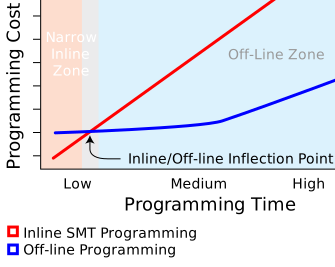 When programming times are in excess of the beat rate (beat rate is the total throughput per time on an SMT line) of the SMT line, inline SMT programming becomes less attractive because the programmer is not providing enough parts to keep up with the line speed. In short, programming becomes the line bottleneck. As data density, device complexity, and the number of devices continue to increase, the need to reduce the cost of programming will be amplified like never before. Inline programming becomes less cost-effective and less time-effective as programming time increases because multiple units may be required to keep pace with the line beat rate.
Inline is Wide
Inline solutions attach at the tape feeder table and are large compared to standard tape feeders, taking up to 6 (or more) feeder positions on the placement machine. Depending on the complexity and mix of devices delivered on the tape reel, there may not be spare “real estate” for an inline programmer. It’s important to verify there’s room before committing to an inline solution.
Multiple inline programmers may be required per machine if the programming time is longer than a single system can keep up with, or if multiple programmed devices are needed. That has a double cost: less available tape space, and the expense of additional inline programmers. The potential requirement to add another placement machine makes device programming inline a very expensive process.
Socket Capacity
Inline SMT programming solutions typically utilize sockets to program devices. These sockets are the electro-mechanical interface that uploads the signal from the computer to program a device. A small robotic mechanism moves the blank device into the socket and then returns the programmed device to the tape, which feeds directly to the SMT pick-and-place machine. Sockets are “consumables” and require cleaning, maintenance, and periodic replacement. If a socket fails during production, the SMT line may idle until it is replaced. BPM Automated systems have built-in fault tolerance; if a socket fails, the system simply bypasses that socket until it can be replaced—reducing downtime and maintaining throughput.
Backups
Inline programmers often require redundant backup units because of the high cost associated with line-down events. Depending on the number of SMT lines and the diversity of equipment brands, each placement machine may require dedicated inline programming hardware that cannot be shared across platforms.
Expensive
Inline SMT programming solutions tend to be costly, especially when backup systems are required. If the SMT line is idle, the inline programmer is idle as well. If expensed using a standard five-year depreciation, there’s no guarantee that an inline programmer will not be sitting unused while it is still being paid for—possibly due to changes in project requirements or programmable devices. With product life cycles becoming shorter, it’s essential to evaluate the financial model before investing in inline programming.
Crystal Ball
It can be difficult to predict what your SMT line will require in the future. If your project changes or design modifications call for different programmable devices, your inline programming solution may no longer be useful. Increasing data requirements also tend to slow programming times, which may require additional inline hardware to maintain line throughput.
Off-line Programming
Off-line programming is a separate process where blank chips are programmed on high-speed robotic systems and placed into output media, usually tape. Off-line machines are best suited for medium to high volume and high-mix requirements. They offer greater flexibility, larger capacity, and can quickly adapt to new projects without becoming obsolete.
Flexible
Flexibility comes from the socket technology. Depending on the device, up to 4 sockets can be installed on each site. This allows for thousands of devices per hour—depending on programming complexity and optional operations such as laser marking.
Same Process
Off-line programming uses the same tape-based process as SMT placement machines. Reels of components are loaded by the operator, programmed, and returned as reels of programmed devices. These reels take up fewer feeder slots than inline programming systems and support uninterrupted production with multiple output reel locations.
Scalable
Off-line systems are scalable. As production needs grow, additional sockets, sites, or machines can be added. BPM systems are designed for three-shift operation with over 85% utilization and can support multiple SMT lines from a single off-line system.
High Mix
Inline SMT programming systems are generally not suited for high-mix environments, as each system is dedicated to a specific device type. BPM Automated systems can switch jobs in 15 minutes or less, offering far greater productivity and flexibility.
Small Footprint
Automated programming systems are compact relative to their capabilities. BPM’s latest system, the 3928, is just 162 x 96 cm and capable of programming 28 devices simultaneously. Systems install quickly and require only standard power and compressed air.
Conclusion
| Inline SMT Programming | Off-line Programming | |
| Number of tape slots on SMT machine | Up to 6 for each device | 1-2 (depends on device/tape width) |
| Number of programmers | 1 for each device (plus backup) | 1 (can supply several SMT lines) |
| High volume programming | Yes | Yes |
| High mix | No | Yes |
| Universal | No | Yes |
| Require advanced operator | No | No |
| Scalable | Limited/ Expensive* | Yes |
| Need backup systems | Yes | No (spare site recommended) |
*Inline is scalable but the cost is double to go from 1 to 2. Offline has an incremental cost much less than inline
Inline SMT programming is a solution to consider for high volume, low mix programming with very short programming times. It lacks the flexibility available from off-line programming systems. With advances in complex programming, especially for automotive applications, inline may be a good fit now, but will that still be true a year from now? For a growing number of companies and applications, off-line programming may be a future-proof investment that generates positive ROI in weeks, not years (see ROI article).
For more information about BPM’s Automated Programming Systems or to speak to one of our experts about your particular requirements, please call +1 (713) 688-4600 or toll-free in the US or Canada (855) SELL BPM.
BPM launched its latest small-footprint Automated Programmer, the BPM310, in November of 2021, with even more capacity than the 3928- up to 48 devices programmed concurrently.